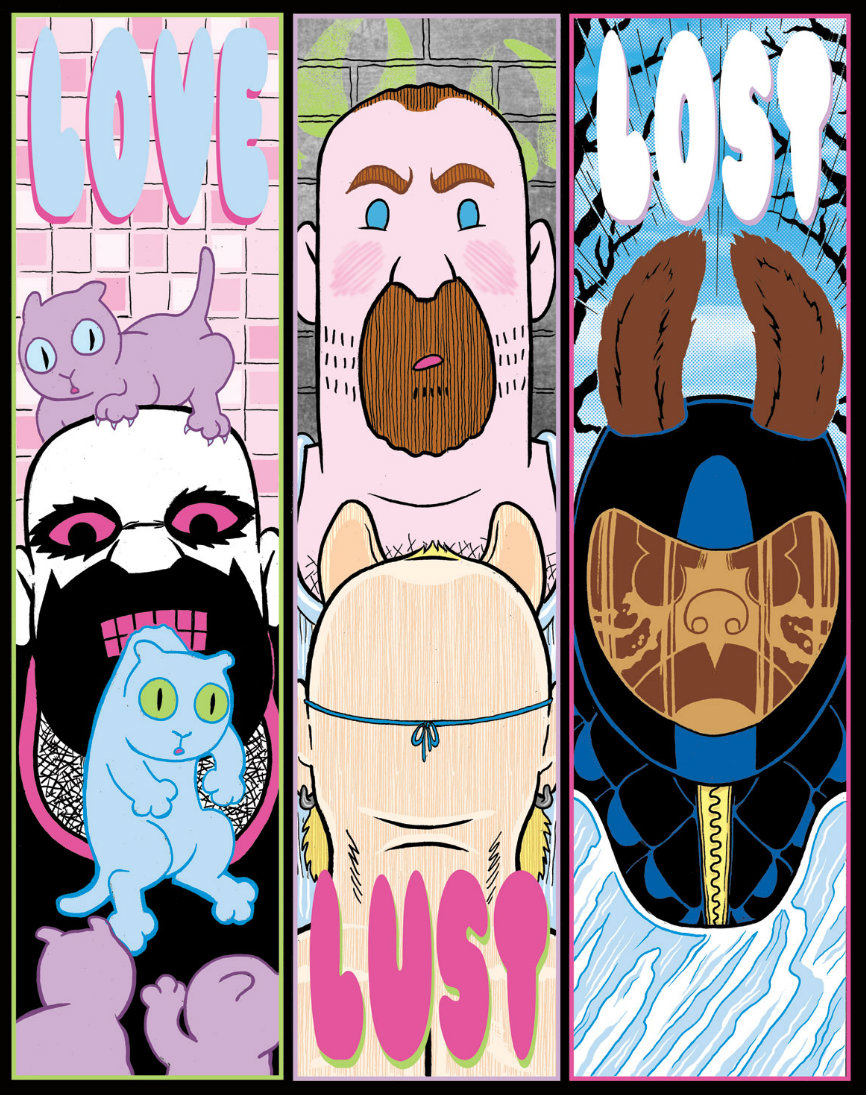
The Banal and the Profane: Martin Wilson
Posted on April 30, 2013 by Edit Team in The Banal & the Profane
“…I woke up with the same thought I always wake up with:Â This is the week Iâll get more writing done.”
âThe Banal and the Profaneâ is a monthly Lambda Literary column in which we lift the veil on both the writerly life and the publishing industry. In each installment, we ask a different LGBT writer, or LGBT person of interest in the book industry, to guide us through a week in their lives.
This monthâs  âBanal and Profaneâ column comes to us from book publicist and writer Martin Wilson. (more…)
Luis NegrĂłn: The Cruel Gay World
Posted on April 29, 2013 by William Johnson in Features, Interviews
“…’gayness’ questions the idea that society has of itself.”
Luis NegrĂłnâs striking debut short story collection, Mundo Cruel (Seven Stories Press), mines the emotional lives of âa small community in Puerto Rico joined together by its transgressive sexuality.â In a wry voice that seamlessly combines both sincerity and camp, NegrĂłn examines how desire, love, and sexuality simultaneously inspire and warp the citizens of Santurce, Puerto Rico. (more…)
‘Speaking Wiri Wiri’ by Dan Vera
Posted on April 25, 2013 by Charlie Bondhus in Poetry, Reviews
âWiri Wiriâ is not, as one might guess, some little-known dialect. Nor is Dan Veraâs Speaking Wiri Wiri (Red Hen Press) an attempt to appeal to the linguistically esoteric. The title is a term invented by Veraâs father to mean âgibberish.â Yet there is no gibberish to be found in Veraâs Letras Latinas-winning poetry collection. Rather, there is much to inspire awe and provoke reflection. (more…)
Folk Tales, Fairy Tales, and Dreams Come True
Posted on April 24, 2013 by Dick Smart in Opinion, Romance
Missionary Position
Companions (Nichâooni) is an astonishingly powerful self-published novel by Jed A. Bryan (BecHavn,2012) that explores two unfamiliar American folk cultures, the Mormon Church and the Navajo Nation. In 1968, young Anglo missionary, Elder Johnny McKay is teamed up with his Pueblo-German missionary companion, Elder Geoffrey Rama, to preach the Mormon faith to âGodâs chosen people,â the Navajo Nation. Itâs hate at first sight as the two young men compete to outdo each other in their missionary zeal. The towheaded Elder McKay is stereo-typically âMormonâ with eyes that âexactly match the faded blue of the hottest summer day.â When Elder McKay first lays sight on Elder Rama, he thinks, âHe was undoubtedly the handsomest Indian I had ever seen,â but is quickly put off by Ramaâs cold arrogance, âDressed in a full suit, coat and all. Idly, I wondered whom he thought he was going to impress out here. The Navajos laughed at us behind our backs for wearing such impracticalities as white shirts, slacks and oxfords where the summer heat was often well above a hundred, and sandstorms were as common as flies on a dead goatâŠ.We had an image to maintain. An image of stubborn refusal to adapt.â
But adapt they must. Denied the only means of transport the church allows, decrepit Dodge vans, âWe elders called them DOGs,â the two traverse their large mission territory on horseback in regulation missionary white shirts and ties. Based at a century old trading post, Tsisyi Nanishtâin (Hidden Forest), the young missionaries are soon caught up into the fabric of Navajo life, despite their insistence that the Navajo ways be suppressed by the preaching of the Gospel. Tom Yazzie, a baptized Mormon who nonetheless lives according to Navajo traditions, personifies the Navajo attitude of âgo along to get along.â He tells the missionaries, âYou havenât learned much out here if you donât realize that for a Navajo, being a member of a Christian church is like an Anglo joining
Rotary or the Elks. A Navajo is a Navajo. Anything else is superfluous.â Tom secures for Johnny and Jeff an abandoned hooghan believed to be haunted after the suicide of Tomâs nephewââHe was what we call a nĂĄdleehâŠThe plains Indians call them berdache.â
Though the two are inseparable from dawn to midnight, repairing the hooghan, praying, studying and proselytizing, they hardly speak to each other. But Tom sees through their mutual hostility. He tells Johnny, âIâd be willing to bet that you donât see it, but the trouble is that you and he are too much alikeâin some ways.â In their competitiveness they have baptized more Navajos than any other team on the reservation, but their mutual hatred reaches the point of a bloody fist fightâa scene beautifully illustrated on the bookâs cover by an uncredited artist, perhaps Mr. Bryan, himself? Bryanâs resolution of the young menâs repressed love is a masterstroke of yearning and restraint.
Bryan never stereotypes either the Mormons or the Navajos but instead invites the reader to understand the way of life that so strongly binds both communities. His portraits of the missionary teams and their irreverent attitudes towards the clueless church hierarchy provides many of the books more comic moments, even while he keeps the reader aware of the sincere faith that motivates their sacrifice. Likewise, the Anglosâ perception of the Indians is comic, but Johnnyâs growing self-awareness helps him to become aware of the wisdom and dignity and oppression of the dinĂ©. So much so that he begins to incorporate some of their spirituality into his own faith, a heresy known as âtraditionalism.â While proclaiming the Indians âGodâs chosen people,â they are simultaneously disdained as Lamanitesâa fallen race whose ultimate redemption is becoming white. Similarly, Johnny and Jeff can only be redeemed by becoming something that theyâre not.
In a scene evocative of Walt Whitmanâs âI Sing the Body Electric,â Tom invites the missionary teams to join him in the sweat lodge. Apart from their apprehensions about participating in a native ritual, the young men arenât allowed to remove their Temple garments except to bathe. Finally, the district leader reasons that the sweat lodge is a bath of sorts, so all the young men strip down and in the dark confines of the sweat lodge, skin touching skin, they listen to Tomâs haunting chant. Soon the young Mormons begin to sing their own traditional hymn, expressing âthe waves of loneliness, the despair of being denied love.â Itâs too sad to even smile at the obvious double entendre:
âSome poor fainting, struggling seaman,
You may rescue,
You may save.â
Johnny and Jeffâs tragedy, the tragedy of their Mormon faith, is that while saving others, they cannot save themselves and remain Mormon.
Among the bookâs many delights is a vivid depiction of the young missionary teams playing basketball in their Mormon union suits, rear flaps flying. Bryan includes many other interesting details of Mormon and Navajo life, including a Navajo pronunciation key as an appendix. Perhaps more useful would be a short lexicon of the many Navajo words and phrases he uses liberally throughout the book, although generally he does an excellent job of bringing out the meaning of this beautiful language in context. An audio version is promisedâyouâll want to Whispersync the print and audio versions, if available on Amazon.
Shoot Off at the OK Corral
Wyatt: Doc Hollidayâs Account of an Intimate Friendship (Bold Strokes Books, 2012) is billed as an erotic novel rather than a romance, but readers will find this fascinating historical Western by m/m writer Dale Chase amply satisfies both needs. I have classified the book as a folk tale simply because the story has become larger than life thanks to its silver screen versions. I dare say Chaseâs treatment is much more historically rigorous than those, even with her intriguing assertion of a romantic relationship between Wyatt Earp and Doc Holliday. One wonders where that relationship falls in the authorâs disclaimer that she has âadhered to historical accuracy where it suits the story and loosened the reins where it does not.â
Chase opens with the image of death as âle petit mortisââ
âGunplay gets a manâs blood up. A fellow goes for his revolver, meaning to do me harm, and as I dispatch him, everything in me stands at attention. By the time his life runs out, my blood rushes to such an extent that my dick is hard.â
âand death haunts the story throughout as we know from page one that Doc is dying of tuberculosis. Yet the story moves too fast to ever be morbid. There is plenty of the type of action that will leave lovers of Westerns drooling. Chaseâs language is blunt and unsentimental and the couplings between the sexually adventurous Doc and the upright and married Marshal Earp have the stark urgency of men who need to shoot first and ask questions later. Docâs persistent cough adds a tragic poignancy to their relationship, but Chase works by understatement and she packs more pathos into a four line epilogue than some writers do in entire novels.
Itâs hard to believe that this confident and entertaining book is Chaseâs debut novel. I will be looking for more by Chase at www.dalechasestrokes.com.
âIn Love With a Boulder Manâ
In a recent posting in Lambda Literary Review, Diana Denza wrote about the rise of alternative fairy tales for LGBT kids and Jeremy Jordan Kingâs debut novel, In Stone: A Grotesque Faerie Tale, (Bold Strokes Books, 2012, www.boldstrokesbooks.com) is just such an ambitious attempt to create a new gay fairy tale for young adults. King was featured in the Advocate as one of the ten LGBT YA authors to watch out for.
The contemporary story is simple. Financially struggling New York caterwaiter, Jeremy Jordan King, perpetually in crush with unobtainable guys like his co-worker, Robbie, becomes a victim of a hate crime while stumbling home stone drunk on New Yearâs Eve. Apparently he dies. Or does he? He wakes up being ministered to by a Guardian, the first of his several timely rescues:
âMy superhero wasnât a man at all, but some humanoid monster thing, hunched over and ancient.
I muffled a gasp in my hands, then said, âYouâre aâŠa gargoyle?â
He sighed. âWe are called grotesques. Gargoyles are drain pipes.ââ
The back-story about how Garth became a grotesque is so convoluted it is often difficult to figure out what is going on or why, even though it ostensibly parallels the contemporary story. In a nutshell, long, long ago in a kingdom far, far away, Garth and his friend, Francis, were turned into stone by an evil king. Garth then sat as a Guardian over the crown prince. The prince becomes a victim of a hate crime perpetrated by his evil twin brothers, but instigated by the evil king, and apparently he dies. His friend, a garden statue of a warrior queen, becomes allies with Garth and Francis and Francisâ friend, a fountain statue named Helena. They journey forth to try to rescue the soul of the prince from the Avenging Angel. Well, lots more than that, but, as I said, this is it in a nutshell.
Itâs a pity that King didnât trust more in his basic premiseâboy and grotesque fall in loveâbecause a simpler back-story would have better held my interest and propelled the story. Instead, because the back-story is so complicated, what should be of central interest to the plot, Garth and Jeremyâs relationship, gets lost in the rocks. At the end we finally discover who Jeremy really is and why Garth is his Guardian.
In the contemporary story, King cleverly names the protagonist after himself to anchor the story more firmly in reality. Similarly, the character Jeremyâs New York wiseacre voice, though sometimes grating, does keep the story firmly on the pavement in contemporary New York City. Unfortunately, Kingâs portrait of the city is more from a bridge and tunnel crowd viewpointâheâs constantly in danger of being mugged. But King does put the city to good use when Garth finds it easy to hide in plain sight by blending into some of New Yorkâs several Gothic landmarks, such as St. John the Divine Cathedral. Garthâs vigilantism is morally ambivalent and here King properly evokes the violence of many childrenâs fairy talesâthe ones that havenât been Bowdlerized to clean up all the blood.
The allegorical moral of the story, that little gay boys must grow up to face the big bad reality of hate crimes and unrequited love, is not the one I wanted and I think thatâs the reason this chimera of contemporary story and fairy tale didnât work for me. King needs the courage of his brilliant imagination to write a full-blown fantasy. Since this is Book One of The Immortal Testimonies, perhaps he intends to do just that in Book Two, Night Creatures, scheduled out this fall. From the title I am hoping that the new book will feature Bryant, the sexy vampire introduced to us in the first book. If King keeps coming up with such intriguing premises, Iâll keep buying his next books.
The cool cover art is also by King. The photogenic young author can be found at http://jeremyjordanking.com.
Waking Up is Hard To Do
Alex Jeffersâ new novel is 20 years old (and you thought you had a tough time finding a publisher). Originally written in 1991-1992, during the height of the last big recession, it is interesting that it is out just in time for the next big recession. Amazingly it doesnât read like a period piece, but is as fresh as today. The bookâs full title is Deprivation; or, Benedetto furioso, an oneiromancy. Deprivation as in not getting enough sleep and oneiromacy as in the interpretation of dreams in order to foretell the future. Benedetto is the Italian version of the protagonistâs nameâBenedict. Furioso meaning mad as in looney and referring to the Italian epic poem, Orlando furioso. The publisher is Lethe Press, but of courseâLethe being the goddess of forgetfulness and oblivion, or sleep (www.lethepressbooks.com).
If the title needs to be parsed, one may be hesitant to delve into the admittedly rich text. Certainly, Deprivation benefits from a good Italian red preferably while listening to the Giovanni Perin European Quartetâs jazz take on Vivaldiâs âOrlando furiosoâ on the âDream With Open Eyesâ CD.
The story begins with a 30-page dream that has the illogical quality of a dream, best read, as I said, with a buzz on. The 18-year old Dario, the son of an Italian prince, and his two half-siblings, his protective older brother, Laud, and his playful little sister, Gioia, are adrift on the streets of Boston in winter when they are rescued by our protagonist, Ben Lansing, who takes them home with him. Dario becomes Benâs lover. Is Ben dreaming? The three siblings beg for a Freudian interpretation. Ben cannot sleep: âHow did he survive like this, how did he keep going? Surely sleep deprivation, prolonged, was unhealthy.â He realizes that his dreams of Dario are transitioning to âhallucinations, delusionsâ and that soon he will not be able to distinguish the dreamer from the dream.
The book has no chapters, so when Ben wakes up there is no abrupt transition from dreaming to waking and no clear definition that he is awake, merely a gradual sobering into the reality of his daily commute from Providence, RI, to his job at a temp agency in downtown Boston. And then, wham! heâs hit by a humpy Greek bike messenger named Neddy who offers to have his soiled suit cleaned. Jeffersâ description of Neddy is resonant with the subtle allusions that the astute reader will discover throughout this novel:
“‘Iâm Neddy.’” His hair, a dense, hueless black, hung unruly around his narrow face, draped like a silk scarf around his neck to the center of his chest. Five or six thin braids tied with bits of narrow yellow ribbon coiled through the mass. They lashed about whenever he moved his head, or when he raked the hair back from the brow with one gloved hand.”
Neddy stands as the very image of the Renaissance figures Ben views while strolling through a museum–An elongated face like Neddyâs in a painting by El Greco is framed by a black hood similar to Neddyâs scarf-like braids. Or the âgold laces tying offâ a young boyâs cod-piece in a painting by Titian are similar to the yellow ribbons coiled through Neddyâs black braids. Later, at Neddyâs apartment, Ben sees a self-portrait by Neddy in which he has portrayed himself as a Greek kouros.
Meanwhile, when Ben finally gets to work, the office yenta has set up a blind date for him with M. Kenneth Pace, a comfortably well-off translator from the Czech who selfishly takes an unneeded well-paying temp clerk-typist job from Benâs agency, leaving more desperate job seekers high and dry. But the beautiful M. Kenneth, whom Ben likens to Titianâs Portrait of an Englishman, has a surprising sexual orientation. Nonetheless, he becomes a source of refuge for Ben.
In the midst of these dreams and dreamlike encounters, Ben gets a call from his first crush, his Italian teacher and soccer coach from prep school, Paul Antonescu, who Ben claims looks identical to a self-portrait by a Renaissance contemporary of Michelangelo, Andrea del Sarto. Ben daydreams about a momentâs too long tumble he took with Paolo in the soccer field five years earlier, or of the smell of espresso and the mature manâs heat and cologne. Paul is coming out to Boston on his way to Italy on business, may he see Ben?
Fortunately in a novel this psychologically complex, Jeffers provides clues for us along the way. When Ben and Kenneth discuss the book that Kenneth is translating from the Czech, Kenneth tells Ben (and the reader), âThereâre a lot of dreams in Kamilâs book. Literary dreams, sure, important to the plot.â
Ben dreams of sex with his father. Does his father represent Paolo? The phone rings and it is his father, Lon, coming out to his son. The crisis is perpetrated by his mother Sandraâs newest successful novel about a gay father and sonâher method of outing. As Ben reads his motherâs book we follow the novel within the novel like a daydream and Ben is his motherâs fictional gay son Tom and has Italian ancestry and lives in Italy. Mother and Father fly to Boston to see Ben as Ben tries to sort out dream from reality, Neddy from Paul, Paul from his father, Dario from himself. When Ben dreams of Paulâs arrival, the reader knows it is not simply a dream but a dream come true.
Ben reflects that âThe journey not the arrival mattersâ and much of the delight of this novel comes by following the links that are practically embedded in the text (I hope the ebook edition actually has embedded links). With âOrlando furiosoâ as the backdrop, we are introduced to many elements from the poem such as the mythical hippograff and medieval paladins. The mad arias from Vivaldiâs and Handelâs operatic interpretations of the poem form a brilliant soundtrack for this book, download them on iTunes. Jeffers vivid descriptions of paintings by El Greco and Titian illuminate the book from within. With its many references to the Italian Renaissance, the novel could almost serve as a single volume introduction to the quattrocento. You wonât want this dream of a book to end.
The bookâs charming cover was designed by Jeffers. For more of Alex Jeffers, go to http://sentenceandparagraph.com/.
Only 24 hours left to LLF’s 25th Anniversary Online Auction!
Posted on April 23, 2013 by Tony Valenzuela in Foundation Updates
In commemoration of our 25th Anniversary, Lambda Literary Foundation is holding our first ever online auction beginning now for ONE WEEK ONLY through April 30! Take a look at the incredible items below or visit our eBay Giving Works homepage. Remember, the auction runs through April 30 and 100% of the proceeds raised benefit Lambda Literary!
|
EXPLORE EACH ITEM BY CLICKING ON IMAGE
|
|
EXPLORE EACH ITEM BY CLICKING ON IMAGE
|
|
EXPLORE EACH ITEM BY CLICKING ON IMAGE
|
|
EXPLORE EACH ITEM BY CLICKING ON IMAGE
|
Archie Comics, Really Big Coloring Books, and Other LGBT News
Posted on April 22, 2013 by Julie Levine in Features, News
In September of 2010, Dan Parent of Archie Comics added Kevin Keller to the mix, making him the first gay character in the history of Archie Comics. And in February of 2012, Kevin Keller got a series of his own, and around the same time, he also appeared as an adult in Life with Archie magazine, which featured him getting married to his partner Clay. Now, Paul Kupperberg, the writer of Life with Archie, recently released Kevin, a young adult novel that follows Kevin before he met Archie and the gang, starting with his experiences in middle school where he was forced to deal with bullying, and the problems of being âdifferentâ in the midst of puberty. (more…)
Aaron Hartzler: Waiting for the Rapture
Posted on April 18, 2013 by Brent Taylor in Features, Interviews

“A librarian who read the book recently contacted me and said, ‘I loved your book, I just wish there had been more gay content in it.’ Of course my response was, ‘Me TOO!’ I wish I had been able to knock down the closet door at 16 and take the world by storm.”
Aaron Harzler explores sexuality and religion in his young adult memoir Rapture Practice, published this month by Little, Brown Books for Young Readers.
A Look at Anti-Gay Problems in China and France, Camp Aesthetics, and Other LGBT News
Posted on April 15, 2013 by Julie Levine in Features, News
In China, where same-sex marriage is not legal, gay men are looking to get married to lesbian women in order to obtain what is known as a xinghun, a âcooperative marriageââessentially, a marriage in name only. The husband and wife continue to have relations with same-sex partners and are not required to live together either. (more…)
âDoes This Baby Make Me Look Straight? Confessions of a Gay Dadâ by Dan Bucatinsky
Posted on April 14, 2013 by Thomas March in Bio/Memoir, Reviews
Families donât just happen. Gay, straight, single or coupled, nobody could possibly find it easy to build (and maintain) a happy, healthy family. Maybe nobody ever gets it completely right, but Dan Bucatinskyâs  Does This Baby Make Me Look Straight? (Touchstone/Simon & Schuster), a memoir of his experience thus far as a gay father, provides proof enough that compassion, generosity, honestyâand humorâmight just get you close. (more…)
David Eye, “Dance Bar”
Posted on April 10, 2013 by Poetry Editor in Poetry Spotlight
This week, two poems by David Eye. (more…)